
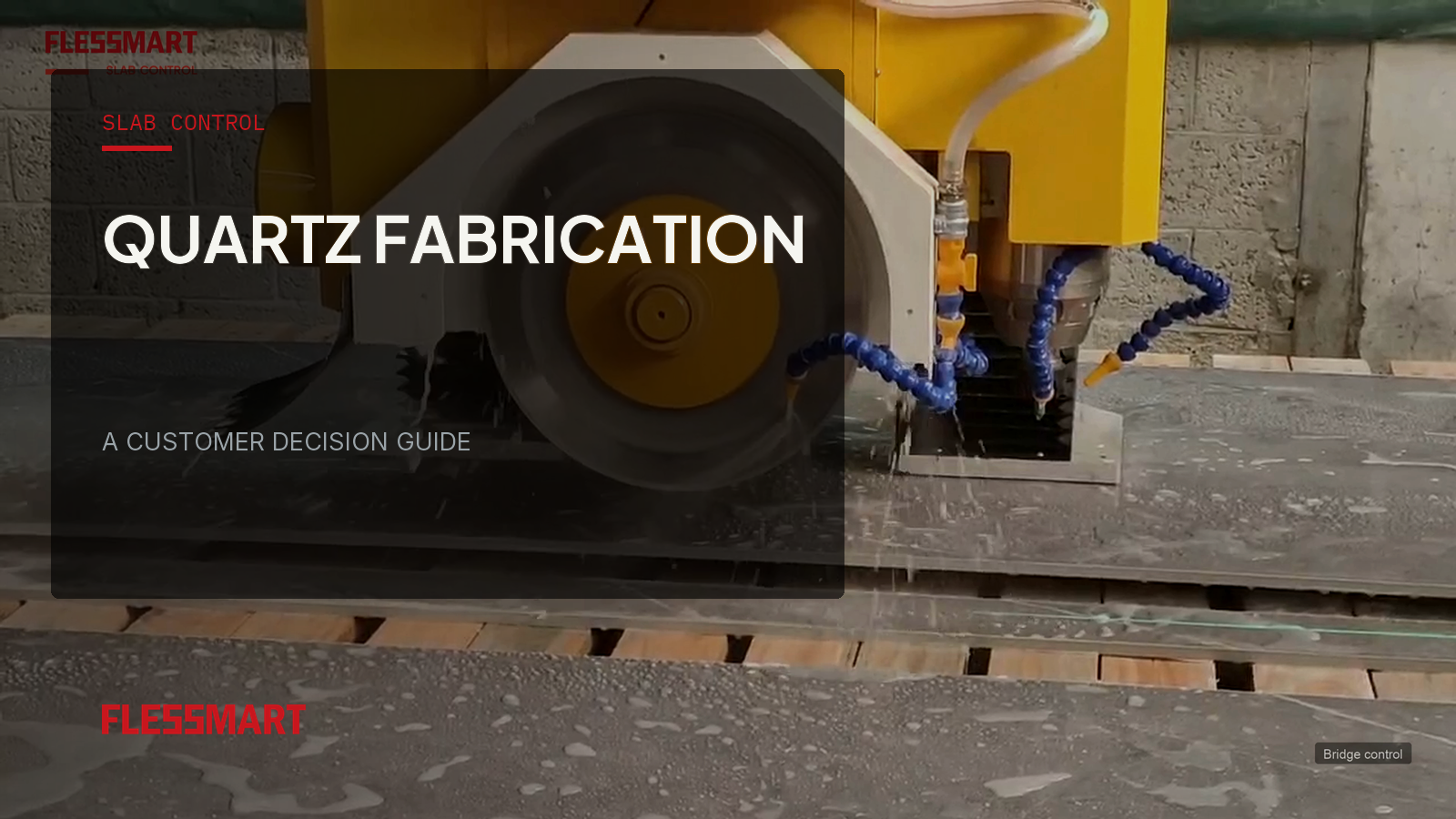
Buying a Bridge Saw for Quartz Fabrication: What's Different
By the FLESSMART editorial team — an engineering-led brand of CNC bridge saws and slab fabrication equipment for stone and solid surface fabricators. See the equipment.
A shop that has cut granite for years sometimes assumes engineered quartz is "just another stone." The assumption is the risk. Quartz cuts differently because it is built differently: a dense aggregate of quartz particles held in a resin binder. What changes is not the bridge saw's basic job, but the conditions it must hold while cutting.
What this guide covers
- Why quartz is not granite
- What a quartz saw must hold steady
- Selection questions for quartz
- The Slab Control connection
1. Why quartz is not granite
Natural stone varies slab to slab and within a slab. Engineered quartz is manufactured to be consistent, which is part of its appeal, but its make-up changes how it cuts.
Quartz aggregate is abrasive. It wears diamond tooling and blades faster than softer materials, so tool condition matters more. The resin binder behaves like a plastic: when the cut overheats, the resin degrades at the edge, leaving a dull, milky, or darkened line sometimes called resin burn. That defect is specific to engineered stone and has no direct equivalent in natural stone.
Cutting quartz also produces fine crystalline silica dust. Suppressing that dust is a safety requirement, not an optional extra, and the water that suppresses dust is also what keeps the blade and the resin cool.
2. What a quartz saw must hold steady
For quartz work, the machine is judged less by a single spec and more by whether it can hold a few conditions through a full day of cutting.
Cutting with adequate water. Water must reach the blade–material interface continuously. If the water flow is interrupted or misdirected, the blade heats, the resin overheats, and the edge burns. The question is not just whether the machine has a water system, but whether the operator can confirm flow at the cut.
Feed control that avoids overheating. Pushing the blade too fast loads the segments and heats the resin. The saw should let the operator control feed rate and cut depth so the cut stays cool. This is an operating discipline the machine should make possible.
Tool condition and sharpness. Dull blades and profile tools generate friction and heat before they visibly fail. A quartz operation needs a tooling plan — when tools are dressed or replaced — as much as it needs the saw.
Clean edges and corner support. Quartz is uniform, which makes seams and corners more visually demanding. Chipping at an edge or a corner shows more clearly than it would on a naturally varied stone, so edge quality and support during cutout matter.
3. Selection questions for quartz
- What tooling and blades will this work require, and who maintains them?
- Can water flow be confirmed at the cut interface during operation?
- Does the saw allow the operator to control feed and depth to keep the cut cool?
- Does the dust-control setup match the silica exposure requirements in the shop's region?
- Will the table support a full slab without flexing at the corners?
- Can the shop achieve the edge and seam quality the customer will inspect?
The Slab Control connection
Slab Control identifies where uncertainty enters a workflow, defines the decision it affects, and requires evidence appropriate to that decision. In quartz fabrication, the uncertainty is concentrated in heat, tooling wear, and dust — three conditions that are invisible until the cut is already wrong.
A bridge saw for quartz is therefore selected by asking which decisions the machine must support: keeping the cut cool, keeping tooling sharp, and keeping silica dust controlled. Each of those should be tied to evidence the shop can verify on its own jobs, not to a claim on a spec sheet.
This framework does not replace a supplier's documentation, regional safety requirements, or the shop's authorized tooling procedure. The useful first step is to run one current quartz job, record where heat, tool wear, or dust was not yet under control, and treat those gaps as the selection criteria.
That is where confidence becomes engineered.
Everything Under Control.
How this guide is framed. Slab Control is FLESSMART's management framework for reducing fabrication uncertainty through visibility, guidance and control. This article applies that framework to decision-making; it is not a machine manual, a service schedule, or a substitute for the selected equipment's approved documents and the site's own procedures.
Safety and regulatory references. Fabrication work involving silica dust, energy isolation and machine operation is governed by published guidance, not by a vendor article. Refer to the primary sources: NIOSH silica exposure in stone fabrication, NIOSH 2026-101, and OSHA control of hazardous energy.
About FLESSMART. FLESSMART is an engineering-led brand of CNC bridge saws and slab fabrication equipment for stone and solid surface fabricators. Slab Control is its philosophy for reducing fabrication uncertainty through visibility, guidance and control.
If you are sizing a machine for your own work, start with the Full Control 530 specifications and the system overview. For a specific job — material, slab size, cut list — send the details and we will answer with the numbers that apply to it.